


Septic and Wastewater Tanks
A septic tank treats household wastewater and sends the liquid to a drain field. A holding tank stores it until a truck pumps it out. Start with what your soil, your site and your health department allow, then pick the tank that fits.
What a septic tank and a holding tank do
A septic tank is the first stage of an on-site treatment system. Solids settle to the bottom as sludge, bacteria break them down, and the clarified liquid, called effluent, flows out to a drain field where the soil filters it. A holding tank does no treatment. It is sealed with no outlet and stores everything until a truck pumps it out. Your local health department decides which one your site can use and what size it must be, and issues the permit.
The problem to solve
- Soil and space. A septic tank needs suitable soil and room for a drain field. Where poor soil, a high water table or a small lot rule that out, a holding tank is the option, if your health department allows it.
- Pumping and size. A septic tank is sized by bedroom count and pumped every few years. A holding tank fills steadily and is pumped far more often, sometimes monthly, so size it to the wastewater you produce between pump-outs.
- Burial depth. Standard duty tanks suit shallow burial in yards. Deeper burial, a high water table or higher loads call for a heavy duty tank.
- No place to dig. For a job shack on a construction site, or to store sewage above ground, choose a tank that sits on the surface with no hole to dig.
- Permits and approval. Septic and holding tank installs both need a permit and inspection, and a septic tank must be approved in the state where it is installed.
Solutions
Buried tanks for a home or building
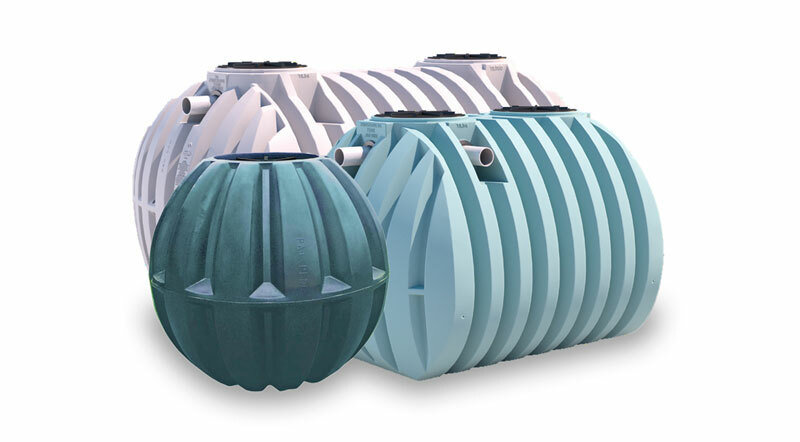 300 to 1,500 gallonsSeptic tanks (standard and heavy duty)Poly tanks that settle solids and send clarified liquid to a drain field: standard duty for shallow burial, heavy duty for deeper burial or higher loads.Shop septic tanks
 300 to 5,025 gallonsSeptic holding tanksSealed tanks with no drain field that store wastewater until it is pumped out. For poor soil, a high water table, a small lot or a seasonal cabin.Shop septic holding tanks
 Lids, risers and pump vaultsSeptic tank accessoriesLids and risers for access, safety access equipment and pump vaults for the tank you choose.See septic tank accessories
 Up to 20,000 gallonsUnderground fiberglass tanksBuried wastewater storage above the poly sizes. Standard tanks bury up to 36 inches deep; traffic-rated tanks suit deeper installs or driveways.See underground fiberglass tanks
Tanks that sit above ground
 250 and 350 gallonsJob shack holding tanksYellow Quadel tanks made for a job shack on a construction site. They collect wastewater and hold it until it is pumped out, with no hole to dig.Shop job shack tanks
 Sized per projectAbove-ground fiberglass septic tanksFiberglass tanks for above-ground waste and sewage storage. The ultraviolet (UV) gel coat stands up to weather, the shell will not rust or dent.See fiberglass septic tanks
 Standard or project sizesFiberglass basinsFlat-top fiberglass tanks with a bolt-down fiberglass-reinforced plastic (FRP) lid, used above ground as a septic tank, a sewage lift basin or a wastewater holding tank.See fiberglass basins
Sizing and guides
- Septic tank vs holding tank
How each one works, what your site needs and when a holding tank is the answer.
- Septic tank sizing calculator
Turn your bedroom count into a planning size, then confirm it with your local code.
- How a septic system works
The tank, the drain field and the soil, step by step, and how to keep the system healthy.
Questions we hear
Do I need a septic tank or a holding tank?
For a permanent home with room and suitable soil for a drain field, a septic system is the standard choice and the cheaper one over time. A holding tank makes sense where a drain field is not possible or not permitted, for a seasonal cabin or as a temporary solution. Your local health department has the final say.
What size septic tank do I need?
A 1,000-gallon tank is the common minimum for a home with up to three bedrooms, plus about 250 gallons for each additional bedroom. Use the sizing calculator to plan, then confirm the size with your state and county code. For a home that needs more than 1,500 gallons, ask us about pairing two tanks.
How often does a holding tank need pumping?
It depends on the tank size and how much water you use, but far more often than a septic tank, in some cases monthly. A septic tank is usually pumped only every few years.
Is a poly septic tank approved in my state?
Approvals are handled state by state, and county rules can add to them. AK septic tank pages list the states each model is approved in; for any other model or state, ask us before you order.
Request a quote: Septic and Wastewater Tanks
Send the number of bedrooms or the daily flow, your state and county, and whether the tank is buried or above ground; a tank specialist replies with pricing and freight.