


Industrial Water and Bulk Storage Tanks
An industrial water tank holds the water a plant, data center or process line runs on, so work continues when the supply line cannot keep up. Start with what you are storing (water, a process liquid or a dry material), then pick the tank that fits the volume and the site.
Request a quoteSize your reserve with the water tank sizing guide
What industrial water storage is
It is on-site storage for the water a facility uses in its work: process water for manufacturing, makeup water that replaces what cooling towers evaporate, a fire reserve, and a buffer that keeps water on hand between pump cycles. The same sites often store process chemicals and dry materials such as cement, sand, grain or plastic pellets, each in a tank matched to what it holds. Your engineer sets the demand and how long the reserve must last; the tank type follows from what you store and where it goes.
The problem to solve
- Volume. Process lines and cooling towers draw water around the clock. Size for peak daily demand, then add a reserve in case the refill source is interrupted.
- What you store. Potable water, process water and chemicals each need their own material, liner or coating. Dry materials need a silo cone designed so powders and grain keep flowing instead of bridging.
- Steady supply. A pump system needs water on hand between pump cycles. A hydropneumatic tank holds it under a cushion of compressed air.
- The site. Footprint, height limits, equipment rooms and delivery access narrow the choice of tank.
- Code and review. Most states require hydropneumatic tanks to be American Society of Mechanical Engineers (ASME) stamped vessels. Engineered steel tanks can come with sealed drawings for review by your engineer and the authority having jurisdiction (AHJ).
Solutions
Water for process, cooling and supply
 Up to 5,000,000 gallonsBolted steel tanksLarge process, cooling and fire water reserves. Panel sets bolt together on site, even at confined or remote locations, with a coating or liner matched to the liquid.See bolted steel tanks
 1,500 to 250,000 gallonsCorrugated steel tanksGalvanized steel panels with a liner, shipped in sections and assembled on site, for high-volume process and makeup water.See corrugated steel tanks
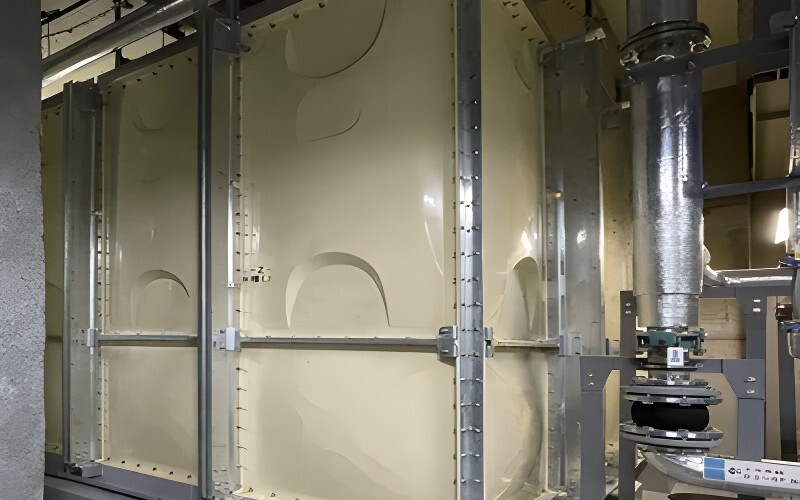 265 to 320,000 gallonsModular fiberglass tanks (HISHITANK)Square fiberglass-reinforced plastic (FRP) panels bolt together with no crane or welding, so the tank fits equipment rooms and retrofits in existing buildings.See modular fiberglass tanks
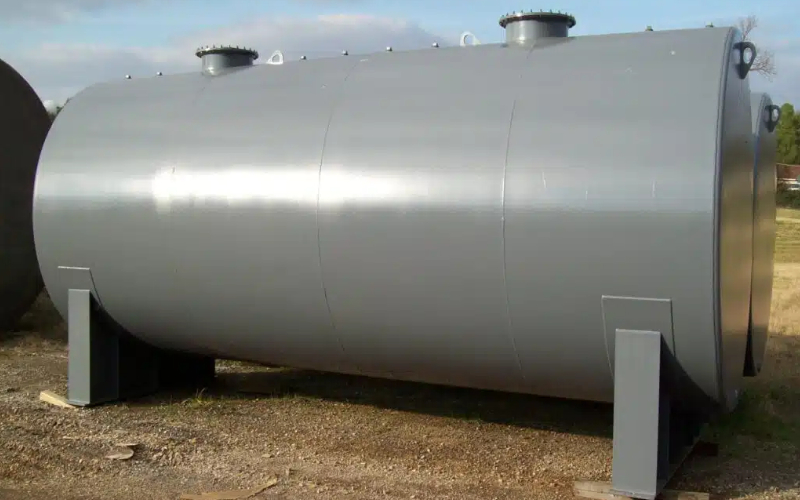 200 to 30,000 gallonsHydropneumatic tanksAn ASME-certified steel vessel that holds water under a cushion of compressed air for a pump system, lined with polyurethane or epoxy for potable water.See hydropneumatic tanks
 Up to 500,000 gallons above groundFiberglass tanksCorrosion-resistant tanks for drinking water, greywater and production fluids, above ground or buried (to 20,000 gallons, traffic-rated models available).See fiberglass tanks
Chemicals, process liquids and dry bulk
 1 to 20,000 gallonsChemical and industrial tanksPolyethylene or polypropylene tanks for acids, alkalis and process chemicals, in vertical bulk, cone bottom, open top and double wall styles you can order online.Shop chemical tanks
 Sized per project to your materialDry bulk tanks and silosBolted or welded steel silos with flat or cone bottoms for cement, sand, aggregates, grain, fertilizers, plastic pellets and powders.See dry bulk silos
Sizing and guides
- What size water tank do I need?
Multiply daily use by how long the reserve must last, then add a margin for peak demand and slow refills.
- Data center water management
Cooling tower makeup water, fire reserves and how much storage a mission-critical site keeps on hand.
- Chemical storage solutions
Why the tank, fittings and pumps must match the chemical name and concentration before you order.
Questions we hear
How much water storage does a plant or data center need?
Start with peak daily demand and how long the site must run if the supply stops, then add a margin for slow refills. For mission-critical sites such as data centers, industry practice is a reserve that sustains operations for 24 to 48 hours without outside supply. The sizing guide walks through the math.
Which tank type should I choose?
For large water reserves outdoors, choose bolted or corrugated steel. For equipment rooms and retrofits, modular fiberglass panels assemble without a crane or welding. For a pump system, choose a hydropneumatic tank. For corrosive liquids or buried storage, choose fiberglass, and for chemicals up to 20,000 gallons, a polyethylene or polypropylene tank.
What does a hydropneumatic tank do?
It holds water with a cushion of compressed air above it, so a pump system has water on hand between pump cycles, and it acts as a buffer tank in high-capacity systems. Tanks are built to ASME Section VIII, Division 1, and most states require an ASME-stamped vessel. For a quote, send the pump flow and cycle rate, the design rating and whether the water is potable.
What do you need to size a dry bulk silo?
The material name, bulk density, storage capacity, refill schedule, discharge rate, available footprint and height limits. Tell us about any flow problems such as bridging so the cone and flow aids are designed for them.
Request a quote: Industrial & Process Water
Send the capacity, the site and the intended service; a tank specialist replies with pricing and freight.