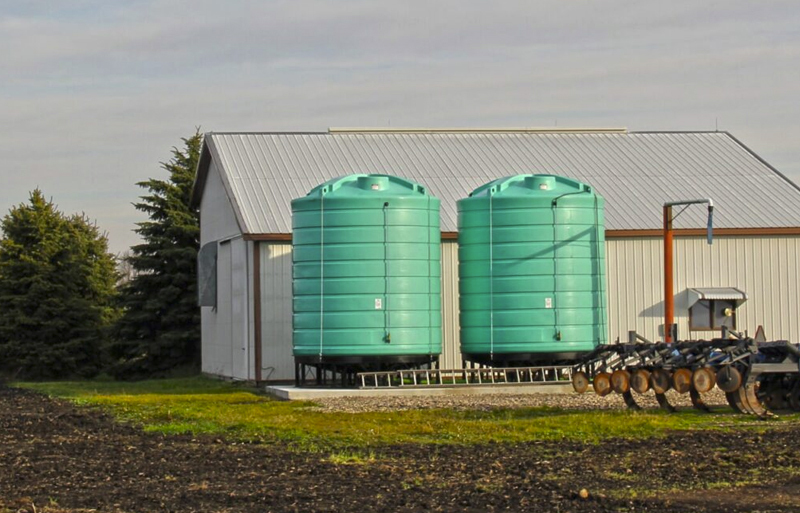
How to choose a cone bottom tank
- Start with the liquid. Know the chemical name and its concentration before you pick a tank. The fittings, valves and pumps must suit the liquid as well as the tank does, so check chemical tank compatibility and SPCC first.
- Pick the top for the work. A closed or solid top keeps the contents covered for storage, while an open top leaves room to add and mix material batch by batch. Peabody ProChem tanks come in both open top and solid top versions, and Custom Roto-Molding offers white open top models.
- Choose the cone angle. Angles differ by brand: Enduraplas tanks have a 15-degree cone, while Peabody ProChem tanks come with 22.5, 30 or 60 degree cones. If your process or engineer names an angle, filter for it.
- Check the outlet. Enduraplas cone tanks drain through a 3 inch FNPT bolted Banjo fitting at the bottom and have 4 built-in tie-down points. Match the valve and hose on that outlet to the liquid, too.
- Plan for the site. Enduraplas tanks block light completely, so algae cannot grow inside, and suit indoor or outdoor use; green and black are the standard colors. For chemicals that need a second barrier, see secondary containment systems or double wall tanks. Your local code or inspector decides what is required.
Cone bottom tank questions
What is a cone bottom tank used for? The cone sends everything to one bottom outlet, so no dead zones are left behind. Buyers use these tanks to mix and store chemicals such as acids, bases, salts, detergents and pesticides, to keep diesel exhaust fluid (DEF) free from crystallization, and to hold grain or cattle feed that dispenses through a bottom flange or slide gate.
Can a cone bottom tank work as a settling or sludge tank? Yes. Cone bottom tanks store sludge and slurry such as wastewater, sewage and manure, and the cone helps separate solids from liquid and drain them quickly. They also handle heavy materials and liquids that tend to form sludge.
Do cone bottom tanks meet ASTM and NSF standards? That depends on the brand. Enduraplas lists its conical tanks as compliant with ASTM and NSF/ANSI standards, and the conical bottom tanks for sale guide names each one. For other brands, check the product page, and confirm with your engineer or inspector which standard your project calls for.
When should I choose a cross-linked polyethylene (XLPE) tank? WST's chemical storage guide points to XLPE for harsh chemicals such as acetic acid or acetone, since it lasts longer than standard polyethylene under chemical exposure. It also names XLPE cone bottom tanks for water treatment chemicals like liquid ammonium sulfate. See chemical storage solutions.
Which cone bottom tanks come with a stand? Chem-Tainer sells cone bottom tanks with a poly stand, including open top cylindrical models. Norwesco offers tanks with a stand in sizes such as 175, 1,050 and 3,000 gallons, and Peabody Engineering has a 125 gallon, 30 degree tank with a plastic stand.